At this point (we hope) you’ve likely read a few of our previous blog posts and are now an honorary Blacoh expert. But in case you haven’t, here’s a quick recap: Transient events (also referred to as “surge” or “water hammer”) occur in all fluid pump systems, the magnitude of which is determined by changes in fluid velocity, fluid density, pressure wave speed, and elevation changes. They can happen during pump start-up or shut-down and rapid opening/closing of valves. Transient events can cause catastrophic system damage such as pump and valve deterioration, pipeline failure, and loss of system control—all of which cost time and money to repair.
So, how can you avoid system downtime if transient events are inevitable? Strap in, we’ll tell you.
Different Vessels for Different Applications
It is important to understand what is happening in your system—and where—before you can commit to the correct solution. For example, if the system is experiencing surge from a quick closing valve, you need a surge suppressor. If the problem stems from uneven flow caused by a positive displacement pump, a pulsation dampener is your answer.
PULSATION DAMPENERS
Pulsation Dampeners have an internal flexible bladder, diaphragm, or bellows that separates the pressurized gas charge from the process fluid. The internal gas volume helps smooth pump flow by minimizing pulsation and eliminating vibration.
SURGE SUPPRESSORS
Surge suppressors (also known as surge dampeners) are similar to pulsation dampeners in construction and are installed as close as possible to the quick closing valve. Any pressure surge or vibration is mitigated by the compression/expansion of the pressurized gas.
INLET STABILIZERS
Inlet Stabilizers are pulsation dampeners installed on the inlet side of the pump. Their purpose is to stabilize pressure and fluid flow by reducing acceleration head loss. In turn, this extends the service life of the pump diaphragms and inlet components.
SURGE VESSELS
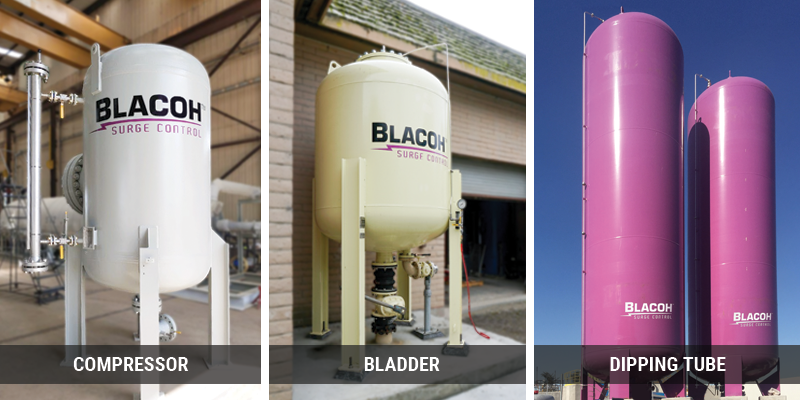
Surge Vessels are customizable hydropneumatic vessels designed for surge protection, pressure regulation, storage, or pump control. They are tailored to various system applications:
- Compressor Vessels (Air/Water): These include liquid level monitoring, a compressor, and controls to maintain pre-charge pressure by adding or releasing air as needed. They can also include interior and exterior coating systems specific to fluid media applications, including NSF61. Instrumentation typically includes a safety relief valve, pressure gauge, gas fill, and vent manifold. Carbon and Stainless-Steel vessels are ASME certified: Section VIII, Division 1 with U Stamp.
- Bladder Vessels: These have an internal bladder that minimizes the need for a compressor system. They come in various materials, including those that meet NSF61 standards. Liquid level monitoring and controls can be included to alarm in low or high liquid level events. Instrumentation typically includes a safety relief valve, pressure gauge, gas fill, and transmitter connection. Carbon and Stainless-Steel vessels are ASME certified: Section VIII, Division 1 with U Stamp.
- Dipping Tube Vessel: This vessel recharges when the process fluid falls below the internal tube, opening a valve to the atmosphere. The length of the dipping tube is designed to correlate to the pre-charge pressure or engineer-specified initial gas volume. They are typically recommended for low pressure applications and systems that allow air into the pipeline. Instrumentations typically includes a safety relief valve and pressure gauge. Carbon and Stainless-Steel vessels are ASME certified: Section VIII, Division 1 with U Stamp.
Understanding all the ins-and-outs of mitigating the effects of transient events can be tricky. There are many choices, and it is important to know when to ask for help.
Need Help? Blacoh's Experts are Here!
To learn more about surge vessels and their benefits for your fluid piping systems, watch our webinar series on water hammer: Transient Monitoring and Surge Vessels.
Click here to watch our Surge Vessels webinar.
Click here to watch our Demystifying Water Hammer webinar.
Click here to watch our Transient Monitoring webinar.